Sunday, June 12, 2011

Days 11, 12, 13 & 14: A week in the big durian

Hello!
If you may remember from one of my former posts, durian is the spiky smell fruit that southeast asian love and many people cannot even stand to try because of the smell.  Apparently, expats call Jakarta the big durian because they have a love-hate relationship with this crazy city.  At first glance, Jakarta is a heaving, spiky, smelly mass but delicious and sweet inside.  As I said in my last post, Jakarta is a study in contrast.  Frustratingly, you can sit in an hour and a half of traffic to travel a very short distance but when you arrive you will be greeted by some of the most hospitable and generous people in the world!


On Monday, we had a super busy and intense day.  It was truly like drinking from a fire hose.  We began our morning with a lecture from Mr. Chatib Basri, an economics advisor and professor.  He spoke about the economy of Indonesia.  Currently, Indonesia is growing rapidly and has a relatively unique demographic bonus.  Unlike other Asian countries, Indonesia does not have the pressure of an aging population because most of their growth is driven by a younger demographic.  Now, as we know, this demographic bonus is not a sustainable competitive advantage because the population will age and then they will have some of the same problems other asian countries have.  However, for now, it has contributed to attracting a lot of foreign capital.  Indonesia is the fourth most populous country and it is also a muslim majority country.  However, Indonesia is really a melting pot of cultural traditions and religious backgrounds and as such they have much more religious tolerance than might be expected.  Mr. Basri spoke about two main challenges for the Indonesian economy: poor infrastructure and corruption.  The Infrastructure is really deplorable here and companies must spend a lot of money and time trying to work within it and around it.  Corruption is still quite prevalent even though there was a huge shift of power and a democratization of Indonesia within the last 12 years. 

After, Mr. Basri’s wonderful lecture, we had the pleasure to speak with three members of the US Embassy.  We learned about what the US does to encourage foreign investment and economic development in Indonesia.  We also learned about how strategically important good relationships between the US and Indonesia is to the US because of the growth potential, population, and religious identity.  Indonesia does not like to take sides in conflict and they have always approached our diplomatic relations very carefully but, because Obama spent time in Indonesia, there has been a marked increase in US favorability for Indonesians.  We also learned about how ineffective and struggling the Indonesian education system is.  USAID works hard with the Indonesian government to try to improve education and education opportunities in Indonesia but with the high levels of poverty, small tax payer base (15 million), and generations of poor education it is an uphill battle.  It made me incredibly grateful for my educational opportunities and even for our arguably flawed educational system in the US. 

After enjoying lunch, we met with three representatives of Indonesian Financial Services.  An executive from Danamon bank gave us an overview of the financial markets and landscape of Indonesia.  I won’t completely bore everyone here but it was truly incredible to learn about the structure of their financial system as it compares to the US.  What a difference!  They have a very open financial system.  Foreigners can own a significant portion of Indonesian firms and they welcome FDI.  However, there isn’t a lot of depth or liquidity in their markets and it is quite unsophisticated compared to ours, London, or Singapore.  To give you an idea of the incredible difference between Indonesian financial markets and ours, the mortgage market makes up a tiny portion of the financial sector and mortgages are only serviced by one bank whereas in the US mortgage banking accounts for nearly 1/3 of our financial sector. This has incredible structural ramifications on their economy.  For example, it is more difficult to establish credit or start a new business because home ownership, as we know it, is not common.  We also learned about Citibank Indonesia from Tigor who was just appointed as head of Citibank Indonesia.  Tigor shed light on the opportunities and struggles of Citi in Indonesia.  Finally, we heard from Jerry Ng about BTPN.  To set the stage, Jerry Ng was our wonderful host and created incredible opportunities for us in Indonesia.  Jerry is a joyful, charismatic, thoughtful, humble, and inspiring leader.  I really could go on about him for forever!  Jerry pioneered a different model of micro-finance in Indonesia.  His model has been wildly successful from a social perspective and amazingly lucrative.  Jerry took BTPN from a small unknown bank into a developing country success story.  Jerry provides financing to small and medium business owners through deposit funding provided by wealthy clients.  The Micro-finance arm charges fair but high interest rates and the funding part of the bank provides competitive interest rates.  Jerry has built this business through scale, simplicity, convenience and speed.  Jerry completely reengineered banking in the developing world.  He re-invented the wheel.  I would be happy to share more specifics about how Jerry achieved this with anyone who is interested. This is a btpn branch:

After a full day of drinking from the Indonesian fire hose, we were graciously invited to dine with Jerry and his family.  We went to the Bunga Rampai restaurant where we ate traditional Indonesian food.  The food was incredible—everything from satay to spicy soup.  The ambience was also incredible.  The restaurant is in a dutch colonial house with traditional architecture and crisp white linens.  It was breathtaking and so fun for all of us to be together. Below is a picture of the restaurant:

The next day, we visited BTPN and got to see Jerry’s revolution of banking in action.  We visited two of his customers and got to speak to them about how they budget to repay their loans and what the loans have done for their businesses.  We also got to see their back room operations and witness a financial training session with some of their customers.  We saw how BTPN leverages technology to make the processes more efficient and to overcome infrastructure obstacles.  For example, the relationship officers go to the business owners and handle the cash transactions remotely through mobile technology.  The mobile technology has thumbprint recognition because many of these entrepreneurs can’t sign their own names and don’t have identity cards. Below is a picture of a typical customer and the training classes they receive:


After that, we went to the joint venture motorbike manufacturing plant between PT Astra International and Honda Motor.  We received a tour of the enormous facility where everything from melting metal to testing the bikes goes on.  Everyday, this particular plant produces over 6,000 bikes.  The efficiency and logistics were astounding.  It’s pretty amazing that this type of physical labor in the hot factories that are creating overwhelmingly noxious smells is an opportunity for many Indonesians to avoid poverty and take care of their families.  We also noticed that there were no women on the factory floor and the workers informed us that this is not because of any mandate but merely because of perceived cultural roles.  We learned about how motorbikes are really popular in Indonesia as a form of transportation and how Honda dominates this market space.  


On Wednesday, we were able to visit PT Kawan Lama.  Kawan Lama means old friend and was started by a man who had a shack where he sold tools.  Through his vision, he built an empire based off franchising ACE Hardwares, creating a tool-line (Krisbow) and aggressively expanding into other industries like real estate, logistics, and toy stores.  We toured their corporate offices where everyone seemed so happy to be working there and the family is intimately involved in all the business’s operations.  I was very struck by the fact that there were no offices in the entire building.  Everyone was seated together in the same open air areas, including the chairman.  After a lovely lunch in their office, some of the executives took us on a tour of their new shopping mall.  The shopping mall is the latest in Kawan Lama’s expansion efforts and their first foray into real estate development.  The shopping mall was clean, modern, and sprawling; we were able to see their full range of stores and products while asking their management about how this project had come to fruition. Here is a picture of their offices:

After a full day with Kawan Lama, we joined some UVa alumni at a bar down the street where we visited with them.  I met a really neat girl, Avina, who works at an Indonesian Private Equity Fund.  She told us about her really positive experiences as an Indonesian woman in the Financial Services sector at an Indonesian firm.  After this cocktail reception, I took the opportunity to take advantage of The Ritz-Carlton’s impeccable spa and had a wonderful massage.  It was really great because we had been so busy.  I was so tired during the massage that I fell asleep during it but it was still lovely!

The next day, we had another early morning. We caught cabs to an office nearby that headquarters PT Lautan Luas, another Indonesian firm.  Lautan Luas offers diversified products and services within chemical manufacturing and distribution.  They have many subsidiaries and joint ventures that creates a fairly complicated corporate structure.  One of those subsidiaries is the Linc Group, a logistics company.  We spoke with the head of Linc Group, who shed light on how businesses cope with the terrible infrastructure and the complexity that an archipelago presents.  I was interested to find out that it is less expensive to ship things to China than it is to ship something from one part of Indonesia to another. We also learned about how Lautan Luas plans to invest heavily in water treatment because water is such a major problem in Indonesia.  The CEO of Lautan Luas is a huge advocate for and supporter of Habitat for Humanity, so he also explained the challenges he faces with Habitat for Humanity Indonesia.  We also spent the last part of the meeting with Lautan Luas presenting recommendations on several real business cases Lautan Luas has experienced.  My group and I tackled a case about a joint mining venture  in a remote part of China where there were management and partnership issues. 

That evening, when we returned to The Ritz, we had a private audience with the manager who oversees The Ritz-Carltons and Marriots in Jakarta.  Pierre was very french and took us through how they build and maintain brand equity through stupendous customer service for The Ritz Carlton.  Pierre had some funny anecdotes and explained the Ritz’s rigorous training for employees and the philosophy it seeks to embody: “we are ladies and gentlemen serving ladies and gentlemen.”  Pierre also spoke to how he does all this and manages the bottom line.  Pierre discussed how he manages developing world problems (power outages) and out of your control situations (earthquakes).  He also frankly discussed the terrorist attack on this particular Ritz and how he managed that crisis.  After speaking with Pierre, we were taken on a behind-the-scenes tour of the Ritz.  We saw everything from the Presidential Suite to the laundry.  It was really neat to see how they accomplish such great customer service after enjoying it for the time we were there.


Next Stop: Yogyakarta!
Love you guys,
Maddy

Tuesday, June 7, 2011

Days 9 & 10: Beginning the week of living dangerously

On Saturday, we spent the day getting our things together for our early flight the next day.  That evening Amy organized a birthday dinner for me at a Vietnamese restaurant (because we couldn’t wait until Vietnam to eat Vietnamese food).  Our dinner was delicious and we wandered out the door and down the street to the raffles hotel area.  We then meandered into the raffles hotel bar, the birthplace of the Singapore sling.  It has a wonderful ambience—all dark wood with old fashioned fans waving from the tall cielings and peanut shells on the floor.  If you walk up to the second floor on a circular staircase, you can hear a band playing everything from big band to more modern music.  We obviously had to dance on the empty dance floor and give some life to the bar.  Our dancing was so popular with all the rest of the patrons that we were rewarded with a resounding round of applause. 

On Sunday morning, we got up at 6am to drive in the pouring rain to Changi airport.  Getting through the airport was a breeze but we soon experienced our first test of patience.  We have quite a few tall boys on our trip who didn’t quite fit into the seats that were designed with shorter people in mind.  Unluckily, three of the tallest boys on our trip got seated all next to each other in the back row of the plane where they couldn’t recline their seats.  We got some good laughs in as we sat on the tarmac for several hours delayed.  The plane ride over was a little dicey but our landing in Jakarta was perfect!  We were greeted by Ritz Carlton representatives and friends of McIntire who ushered us onto a bus for a full day of cultural experiences.  As we drove through Jakarta, the second largest city in the world with 22 million people, the juxtaposition of Singapore Inc. with Jakarta’s bustling chaos couldn’t be more apparent.  We slathered on sunscreen and sucked down some water in anticipation of a full day in the sweltering sun. Our ride to our first destination looked something like this:
Our first day was an exercise in the great disparity and contrast of Jakarta:


We stepped off our bus at Sunda Kelapa.  From the 13th to 16th centuries, Sunda Kelapa was the main port of Jakarta.  It was a main trading post for both the Portuguese and the Dutch.  Today, Sunda Kelapa is no longer the cradle of Jakarta but still quite busy nonetheless.  It is now filled with completely wooden sailboats that transport goods like cement.  


We walked up and down the harbor and even ventured onto one of the schooners to see what it looked like inside.  Here is Julia walking up the plank and trying not to fall into the river: 

 The men who work on these boats also live on these boats.  There is no GPS and all of the navigating is done with hand-drawn maps (at least on the boat we ventured onto).  We mainly saw men unloading cement like this man below.  They often were carrying cement on their back with cigarettes in their mouths as they bounded up and down the planks in the hot sun.
After taking all of Sunda Kelapa in, we hopped in some rickety canoes to go across the river.  The river was full of trash and human waste.  There is hardly any drinkable water in Indonesia and really no sewage system for the poor.  Needless to say, the boat ride across was interesting.  You do not want to fall in. Here are some pictures from that part of the day:


 We hopped off our boat to go through a slum called Kota.  We stepped onto a rickety and dangerous dock and then into a labyrinth of shanty and cement houses.
 Seeing how these people live and how happy they are with what little they have was humbling. We were celebrities there.  Everyone poured into the alleyways to greet us with big smiles and cheerful hellos.  We gave high fives to little kids as we took in the sobering experience.  Below is a picture of the trash pile they live around and the adorable kids who were so happy to see us:


The amazing part of the slum was that it was a fully-functioning self-contained community.  These people do have sources of income, albeit small, and many of them are entrepreneurs.  There is a leader of the slum who keeps order and collects taxes for this service.  It really is astounding to see.  From a business perspective, this was important to experience because we had been talking in theory about the many people who live on 2 dollars a day and how they consume and contribute to the economy.  Then, we got to see this in action.  How does a P&G design their laundry detergent to accommodate the fact that these people don't have very much income or clean water?


After seeing this, we ended in Batavia Square, where we watched some street performers and enjoyed a meal in Batavia cafe:
I will write more as I get more time...
Hope everyone is enjoying!
Love you all,
Maddy


Saturday, June 4, 2011

Days 6, 7, & 8: Further Adventures in the Lion City


A warm hello to all my family and friends! 
Apparently, Singapore has three nicknames:
1. The Garden City (this refers to the numerous greenery and beautiful landscaping that is fully integrated into the urban setting)
2. The Little Red Dot (this refers to the relative size of Singapore when you look at it on a map)
3. The Lion City (the story of this is quite interesting and you can read about it here: http://meridian103.com/issue-7/history/merlion/ but basically it refers to a giant merlion that has become an iconic image in the city, pictured above)

Below are a few pictures of us gallivanting around town from the past few days:


Wednesday was an incredible day for us.  It started with class in on marketing and the Singaporean consumer.  We focused on values and learned about how values have changed over time, how they are different between the US and the Asia Pacific Region, and also on the differences in values among the countries in this region.  I was struck by a few things.  I was reminded of the universality of many of our values including things like accomplishment, self fulfillment, and security.  I was also fascinated by how much this region and especially Singapore is more focused on fulfilling basic needs even though the consumer culture here is so focused on status. 
After a wonderful day with Dr. Tambyah, we got to visit a real life consumer goods company, P&G.  This was particularly wonderful for my group because we had studied P&G extensively for months and could not wait to pick their brains about their global, regional, and local strategies.  The picture below is my team at the P&G regional headquarters (from left to right: laura, amy, lisa, and me!):

The P&G presentation was tailored to accommodate our project and interests so it began with a discussion of the differences in conceptions of beauty between the east and west.  Here are some interesting facts we learned about asian consumers:
1. The average korean women uses an average of 14 products in her skin care regime while the average american woman uses 2
2. Having clear fair skin is a sign of status and equated with beauty here.  Women often undergo skin whitening treatments
3. It is common for Japanese women to shave their faces because the white powder they used is easier to apply on a shaved face
We were then introduced to four trends that are shaping P&G's growth strategy in Asia:
1. Older: the population is aging
2. Richer: many consumers will enter the middle class
3. Smaller: the number of people in households will continue to get smaller 
4. Urban: the trend here is great urbanization as consumers move from rural areas to urban areas 
Then we also got to listen to one of their executives discuss their regional and local strategy in light of this.  She also gave an interesting presentation on the corporate social responsibility and sustainability initiatives P&G has here and abroad.  I was moved by both P&G's commitment to make the world a better place and by the P&G's employees passion for P&G's ethos.  
Finally, P&G gave us a presentation of how they can have a 360 degree view of the global operations and performance of the company through a new Business Intelligence software initiative they have recently implemented.  The software allows them to have a visualization of data that was previously in printed reports that no one could use because it was too tedious and bulky to go through.  Now, managers have an incredible amount of information at their fingertips that they can use to drive strategic decisions.  This demonstration was easily one of the coolest things I have ever seen in my entire life!

Thursday morning was spent studying HR issues in Asia.  Here's some interesting things we learned:
1. Family and relationships are especially important in Asia and there is a sense of duty surrounding them
2. Typically, they are high power distance societies 
3. There is a different sense of personal space and body language can be deeply meaningful 
4. "Face" is very important 
We also learned some fun things about society here and one of their favorite foods that is hard for westerners to stomach because of the overpowering repulsive (to us) smell, durian.  Here's a picture:


Thursday afternoon we had an unbelievable opportunity.  I wish I could express the significance of the corporate visit we got through some miracle.  We visited Temasek Holdings.  Temasek is the name of one of the sovereign wealth funds of Singapore (although they don't call Temasek a SWF).  The other SWF, that Singapore does call a SWF, is the GIC, Government of Singapore Investment Corporation.  Temasek is so called because the original name of Singapore, back when it was a tiny fishing village, was Temasek.  Temasek is the holding company for many government linked companies like SingTel and Singapore Airlines. Also, Temasek makes strategic investments all over the world typically in rapidly growing markets in the developing world.  They like to look for "emerging champions," firms who are doing well but need more capital and greater access to resources Temasek can provide to mature.  Temasek also owns significant shares in american companies like Bank of America.  They were quite helpful in providing liquidity and rescue capital during the global financial crisis.  Temasek is incredibly controversial and secretive.  One of the prominent businessmen here said he has never heard of a group like ours getting a private meeting with Temasek.  We were so lucky!

One controversial thing about Temasek is that its CEO, Ho Ching pictured above, is the wife of the current prime minister and daughter in law to the former prime minister.

Friday was also an interesting day.  We spent the morning in class learning about global strategy and some common challenges Asian firms face.  We did this through the lens of Sony and Samsung.  We learned that Sony has a history of innovation but has suffered in recent years because they can't make their strategy of delivering hardware and software cost effective while delivering on their brand promise of innovation.  Samsung, on the other hand, has mastered cost efficiency and speed to market through an almost militaristic management regime that has hampered a spirit of innovation.  It was also incredible to learn how Samsung is ultimately controlled by a family through an incredibly complicated ownership structure.  This is quite typical of Asian firms and relates back to how families are important and dominate the business environment here.  It also is significant because it shows how oligopolistic these countries truly are.

Friday afternoon was spent going on a corporate visit to Ernst and Young.  E&Y is one of the big four accounting firms.  We got some perspective on their operations in Singapore and throughout the region.  We were further able to see the importance of relationships because E&Y relies upon its reputation and the relationships it fosters with its clients to be an industry leader.  We also learned that E&Y has been particularly busy in this region because of the many IPO's they have been involved in.  Below is a picture of their amazing office building:


Friday night was also wonderful because my friends planned a little surprise for me for my birthday!  We went to La Pa Sat for a delicious dinner and then to a power station that had been converted into a complex of bars.  Some of the girls had arranged for me to have a crown to wear about.  Obviously, this made us stick out even more as if the tall american boys and blonde haired girls weren't enough! We had so much fun and it was really sweet of everyone to think of me.
I think this catches all of you up!
Next time I write, we'll be in Jakarta and there will be many more memories to share!
Love you all,
Maddy

Thursday, June 2, 2011

Days 4 & 5: Singapore, Inc.

  Day 4 marked our first day of classes on the NUS campus.  Our morning sessions were directed by Nitin Pangarkar.  Nitin has a background in Strategic Management and led an amazing session on the Singapore Economy.  From Nitin's unique perspective as an Indian living in Singapore and teaching at NUS for 17 years, we learned so much about Singapore that we couldn't have if we were still in the US.  We learned how Singapore has gone through the amazing transition from a small fishing village, to a British entrepot, to a manufacturing center, to a financial and transshipment hub of the world.  We learned how this transformation has been fostered and guided through the Singapore government initiatives, policies, and planning.  Singapore Inc. is a term used to express how Singapore defies our deeply ingrained idea of governments as dumb, fat and happy.  The Singapore government runs itself and all its projects as corporations.  As a result, Singaporeans enjoy record GDP growth, one of the highest GDPs per capita in the world, low healthcare costs, low tax rates (especially incremental), a reliable retirement investment program (the CPF), and state of the art government services.  Naturally, this nation looks very different from any other in the world.  Even more amazing is that they chose this path in a time when almost every country surrounding them was adopting communism as a form of government.  I have noticed two interesting tensions since my arrival in Singapore.  First, Singapore somehow manages to be both racially, culturally, and religiously diverse while also giving the sense that is a very westernized country.  It is amazing how many people speak English and also how many parts of the city seem like they could be anywhere in the US.   Secondly, I felt that there is an interesting tension between how much the government has their hands in everything but how, at the same time, they allow different government linked corporations to run themselves as they may as long as they run at a profit.  Government agencies or programs that operate at a loss are eliminated or restructured like they would be in the private sector.  It's really an amazing model and it prompts the question of whether something like this can be replicated on a larger scale and in a different context.

That same day, we went on two company visits, HP and Marina Barrage.
HP, pictured above, was a really neat experience because we were able to see the manufacturing side of Singapore.  Singapore has largely moved away from manufacturing because they have a relatively skilled labor force.  Also, the government has sought to diversify their industries into many high value added- high skill industries so this means that manufacturing has relatively decreased.  We were able to see a desktop and laptop production line.  We toured the facility with our guide, a production manager, who explained the process from receiving customized orders to shipping the finished units to the end consumer.  This plant operates 24 hours a day, 6 days a week.  It was really a sight to behold and unfortunately I can't share pictures of it because we were not allowed to take any due to privacy and confidentiality concerns.  The amount of precision, mastery of logistics, and the depth of technical knowledge that goes into these production lines is astounding.  We watched everything from workers screwing pieces in to testing the software.  I also didn't realize that we, as humans, carry electro-static charges that, over time, can damage computers so all the workers wear special clothes and special shoes to help protect the products.  It was also fascinating to see how HP is able to strategically position themselves in Singapore so they can take advantage of cheap labor from the day workers who travel over from Malaysia while still taking full advantage of the business incentives created by the Singapore government.

At Marina Barrage, we were able to experience the ingenuity of the Singapore government firsthand.  Marina Barrage is a dam built in the bay that creates Singapore's 15th reservoir.  As many of you know, Singapore is a tiny island (about 700 square kilometers) and they have very little natural water.  Singapore has four sources of water: imported, desalinized, captured, and new water (ie treated water).  Marina Barrage serves three functional purposes.  The first is that it captures water that can be used by Singaporean citizens.  Secondly, it helps prevent flooding because the gates of the dam can be opened during low tide to let water escape or a pump house can pump water into the ocean during high tide.  Finally, it is a lifestyle attraction because it serves as a tourist attraction and also as a place for local Singaporeans to relax on the grass above the building and learn about sustainability in the gallery located within.  I think Marina Barrages is truly a beautiful example of the power of the way the Singapore government thinks and operates.  Marina Barrage is an example of how Singapore innovates to create resources in a low resource environment.  Also, Marina Barrage is not only functional but it also educates Singaporeans about sustainability and draws them into the experience as a consumer.  I was also fascinated with the way that Marina Barrage talks about New Water. New water is their word for treated water or recycled water.  Oftentimes, treated water has a stigma surrounding it that makes it less desirable but Singapore markets new water as something wonderful and even preferable.  Just by calling it new water, they manage to disassociate it with the fact that it has already been used.  They are just brillant!  Below are pictures of the Marina Barrage from an aerial view, one part of the Sustainable Singapore gallery, and a demonstration of how the gates work:

If you've managed to stick with me through my first day you can see how much I have learned and experienced in just one day!  I can hardly find the time to update all of you but I take every opportunity I can because I am so amazed by everything we are doing and I feel compelled to share it all with you!  The next day was just as special as the first.  We started the morning with a finance professor who gave a three hour lecture on the financial landscape of Singapore.  We learned all about the Monetary Authority of Singapore (the central bank).  I found this part of the lecture fascinating.  The central bank of Singapore does not separate fiscal and monetary policy like we do in the US.  Also, MAS does not do two key activities that central banks typically do.  MAS does not set interest rates and they do not act as a lender of last resort.  If a bank fails in Singapore, there is no bailout money.  Instead of setting interest rates, Singapore controls foreign exchange rates.  It is a very different philosophy and thus far, they have been very successful.  We also learned a lot about Singapore's debt, equity, and derivatives markets.  Some quick things I found interesting were that Singapore doesn't have to issue any government debt (because they almost always have a surplus) but they do because there needs to be a basis for them to build a corporate debt market off of that.  Also, the Singapore Exchange will soon be the fastest exchange in the world. After learning about Singapore as global financial center, we talked through a case on Singapore Airlines.  Singapore Airlines is a government linked corporation.  It has no domestic routes but flies international routes instead.  SIA is well respected in the industry as an industry leader; they consistently report incredible profits and are recognized for their impeccable service.  SIA is a yet another beautiful example of the entrepreneurial spirit of Singapore, their ability to executive both service and efficiency, and how Singapore looks outside themselves to be successful. 
For all this talk of how wonderful Singapore is, we have to remind ourselves that it's not necessarily better.  There are always trade-offs.  One of those trade-offs I have seen is that the people are not necessarily pleased with the government.  This is a one-party system and people do live in fear of the government's reach, influence, and power.  In fact, Singapore just had a watershed election where the dominant party lost some seats and 40% of the electorate voted for the opposition.  Only time will tell how Singaporeans feel about their economic success story and whether Singapore can sustain that story. 

On the evening of our second class day, we were so lucky as to be hosted by the UVa club of Singapore in an alumni home.  We were able to visit with alumni, current, and prospective students sharing our excitement, experiences, and gratitude for what they do to make this experience possible.  I spoke with some fascinating people who kept encouraging me to make Singapore my home after my schooling.  Who knows???... This place seems too good to be real!

I must dash now because we are off to our next event.  There is much more to tell and please share any news from back home with me via facebook or email.
Love all of you,
Maddy

Sunday, May 29, 2011

Days 2 & 3: Eating My Way Through Singapore

I woke up on Saturday morning after 12 hours of wonderful sleep in a real bed.  We gathered together 14 of our friends who had already arrived to the Visitor's Lodge to go on a walking tour of three cultural centers of Singapore: Chinese, Arab and Indian.  Amy, my roommate for this country and one of my teammates for my project, had completely arranged the trip including calling all the cabs and designating where to meet.  We went in four different cabs to the Majestic Opera House.  Unfortunately, one of the cab drivers thought one of the groups meant the Majestic Hotel and dropped that group at the hotel.  Because we didn't have cell phones, we were separated from that group for most of the day.  After deciding that we couldn't find that group, 10 of us began to walk around Chinatown. There were fresh produce stands and many shops with trinkets and silks. There is a large Chinese population in Singapore and they contribute hugely to the culture and economy.  Below is a picture of what one of the streets in Chinatown looked like:
We stopped briefly at this temple to take in the beautiful architecture of this immense temple.  This is the gate of the buddha tooth relic temple:
 Our first real stop in Chinatown was at the Maxwell Food Centre.  Another hawker center where many in our group wanted to try a chicken rice stand (pictured below in blue) that is famous because Anthony Bourdain called it the best chicken rice stand in Singapore.
 After leaving Chinatown with full bellies, we walked through the city center in the scorching heat, crossing rivers and periodically stopping to guzzle water.  We finally arrived in the Muslim center of Singapore where we were first greeted by this beautiful mosque and the smell of amazing Mediterranean food.  We were not allowed to enter the mosque because we were wearing shorts and dresses.  Many Singaporeans are walking around in long pants, long sleeve shorts, and scarves.  I have no idea how they stand it.
After taking in the mosque, we turned to walk down Arab street pictured below.  We stopped in the first shop we saw and I purchased a large fan thinking it would serve me well over the next few weeks.  We meandered down this street taking in all the rug shops, silk shops, and restaurant aromas.
 Next, we crossed the river to wander through the largest flea market in Singapore where vendors were peddling second hand electronics, shoes, and assorted knick-knacks.  We were able to reunite with our four lost group members and proceeded onward towards Little India.
Little India was beautiful! From the colors to the smells, the only word to describe Little India is vibrant.  We went into the Hindu Temple pictured below.  Built in 1827, Sri Mariamman is the oldest Hindu temple in Singapore.  After removing our shoes to enter, we were greeted by smells of incense and intricate colorful paintings of gods and goddesses.  Mariamman is a rural south indian mother goddess who protects against diseases.  
We took the opportunity to rest our weary feet and enjoy some delicious indian food at The Banana Leaf Apolo.  Amy kindly informed us that this particular restaurant was famous for its fish head curry... so famous in fact that The Banana Leaf Apollo holds the world record for the most fish head curry served in a single meal, 1009.  We ate off banana leaves like the people in the picture below:
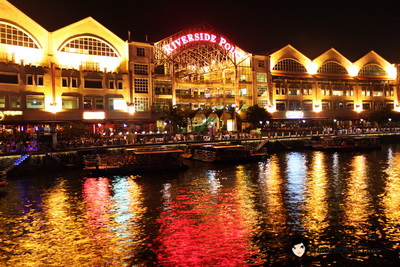
That night, after a brief recoup in the pool, we ventured out to Clarke Quay.  Clarke Quay is a newly designed "mall" of bars and nightclubs on the riverfront that spans over 5 blocks.  The entire area was packed with locals and ex-pats looking to enjoy a saturday night out on the town.  We went out in a big group of 20 or so and took over one of the nightclubs where the DJ rewarded us by playing Frank Sinatra's New York, New York.  Apparently there is a video of Jeff and I swing dancing that is dancing with the stars worthy.  Here's a picture of one small part of Clarke Quay:
 
Day 3 was spent preparing for our classes which began the next day.  We went on a guided tour of NUS, National University of Singapore.  NUS is one of four state financed universities in Singapore and is UVa's partner university in the region.  The campus is extensive, complicated, and impressive.

The business building (pictured below) is a state of the art facility that conducts executive education with partner universities like MIT and UCLA.  
After touring the campus, we were treated to an amazing welcome meal by the program director.  The meal was hosted in the Alumni House right next to the business school at a lovely poolside patio.  While we were told it was a BBQ, it actually turned out to be a traditional Chinese meal, a hot pot.  We were given a plethora of crisp veggies, exotic mushrooms, noodles, seafood, and meats.  Choosing from these items, we were able to cook our own meal in a pot with spicy broth over a gas stove at the table.  It was kind of like a Chinese fondue! The meal lasted for several hours and was truly one of my favorite meals ever.

Thank you for sticking with me,
Miss you all,
Maddy